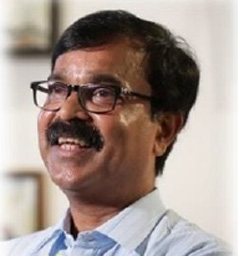
Chandranath Das
After studying Fine Art at the Government College of Art, Kolkata, Chandranath pursued further studies in Cultural Heritage and Restoration in Italy and the UK, completing a Masters and Research degree (AMA). He also received honours such as the Senior Fellowship of the Trevor Walden Trust (UK) and a Senior Scholarship from the Ministry of Higher Education (Italy). A lifelong interest in visual culture, history and conservation has enriched his journey. Regular visits to local museums, conversations with artists and conservators, and time spent in archives have all shaped his understanding of image-making.
My involvement in museology eventually led to the distinction of becoming the first AMA holder from outside the UK in this field, along with the Commendation Medal awarded by the Eastern Command, Ministry of Defence, Government of India, in recognition of his expertise in Himalayan art: honours that he carries with deep gratitude.
The Himalaya that Chandranath engages with is not just a majestic range of peaks, but a lived presence shaped by the people and rhythms rooted in this mountain world. It has never been a distant beauty for him, but a space to dwell in and learn from. His long association with this landscape deepened during his time in Darjeeling, where he had the privilege of serving as the Chief Curator of the Himalayan Mountaineering Institute for over three decades. Darjeeling became both a place of work and a personal retreat, a space where daily life gently gave way to creative discovery.
Rhythms of the Himalayan Yak
This section turns its gaze to the Himalayan Yak; an animal as deeply rooted in the mountain terrain as the snow, wind and stone. Across these works, the Yak appears in varied moods and moments: grazing, walking, watching, nurturing, even confronting. Each canvas captures a fleeting gesture, a quiet instinct, a moment of life stilled in motion.
Often seen as a symbol of strength, endurance and living stillness of the highlands, the yak here is more than just a part of the landscape. It becomes a presence that is solid, watchful and quietly commanding. Through textured brushwork in oil and acrylic, or the stark clarity of charcoal, the artist brings out the density of their fur, the heaviness of their breath and the rhythm of their movement. The use of monochrome tones, especially in the charcoal works, simplifies the scene, helping us focus on posture, contrast and energy instead of details.
The Yaks are part of the landscape not just physically, but emotionally. The artist doesn’t idealise them, but honours their quiet endurance. There’s no attempt to over dramatise. Instead, they are simply allowed to be-solid, rooted, resilient. In doing so, these paintings become less about animal studies and more about a way of being in the world: steady, alert and unshaken.